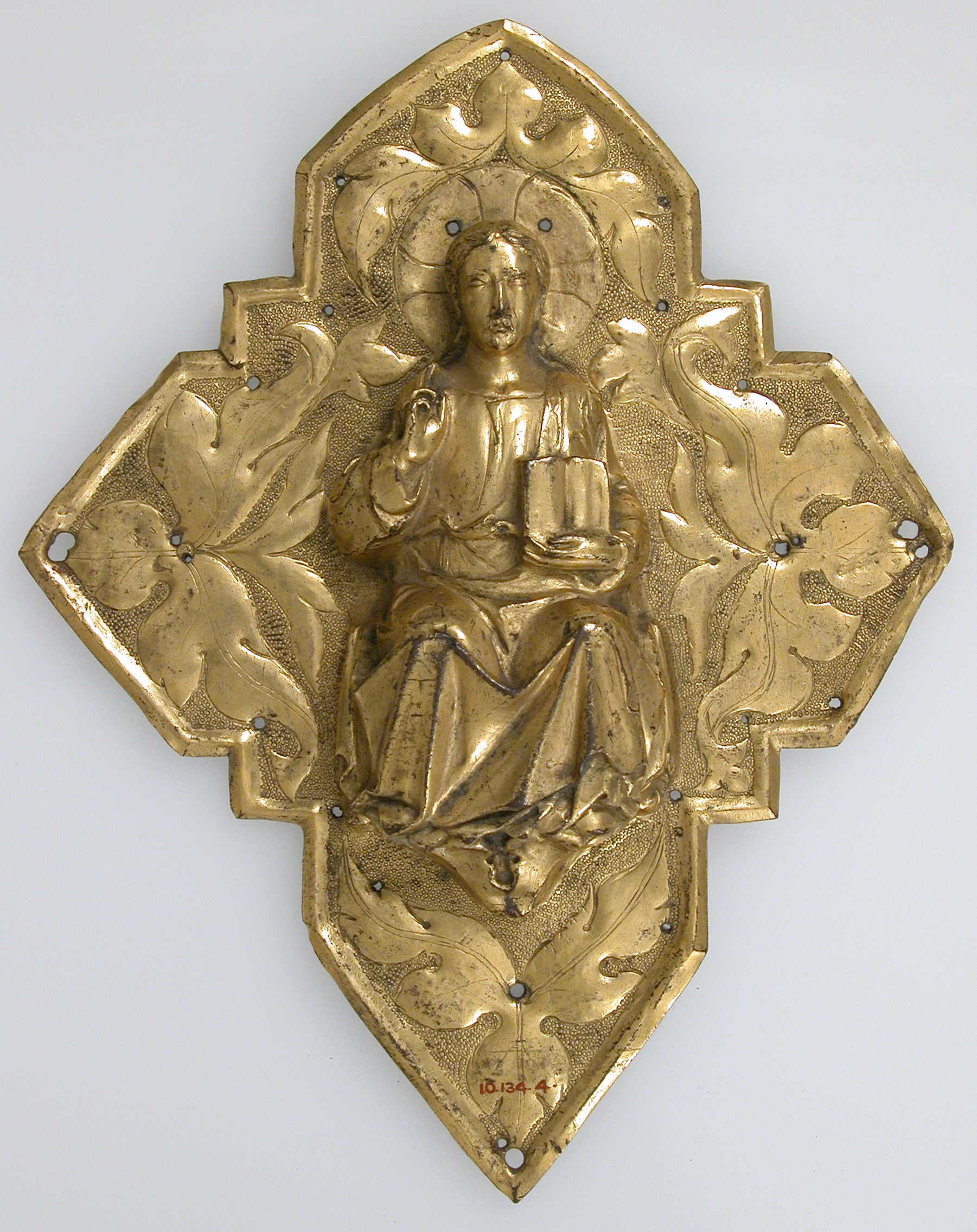
Plaque with Christ in Majesty
Doctrinal reflection
This gilded copper plaque depicting Christ in Majesty (Maiestas Domini) represents a fourteenth-century Italian metalwork object acquired by the Metropolitan Museum of Art through the Rogers Fund in 1910 and currently housed in the Medieval Art collection. The work belongs to a well-established iconographic tradition in which the enthroned Christ is presented frontally, typically displaying a codex or scroll in one hand while raising the other in the gesture of benediction (the Greek manner or Latin variant depending on regional workshop practice). The gilded copper medium situates the object within the broader category of applied arts—altar furniture, book covers, reliquary fittings, or devotional plaques—that transmitted Byzantine compositional conventions into the Italian Gothic milieu. By the fourteenth century, Italian workshops had absorbed Byzantinizing formulae through intermediary channels including Venetian luxury goods, Crusader-era metalwork, and the Italo-Byzantine panel-painting tradition, producing hybrid objects that blend hieratic frontality with emerging Gothic linearity in drapery treatment. The Maiestas type is theologically grounded in apocalyptic vision literature (Revelation 4–5; Ezekiel 1) and carries strong liturgical resonance as an image of the eschatological judge. Scholarly analysis of comparable Italian gilded copper work focuses on workshop localization, punch-work decoration patterns, and the transmission of Byzantine deësis compositional logic into western devotional formats. Attribution to a specific Italian center—Tuscany, Umbria, or northern Italy—requires comparative technical analysis beyond the current museum entry. Sources: Gesta (International Center of Medieval Art); Arte Medievale (Istituto della Enciclopedia Italiana); Metropolitan Museum of Art Bulletin.