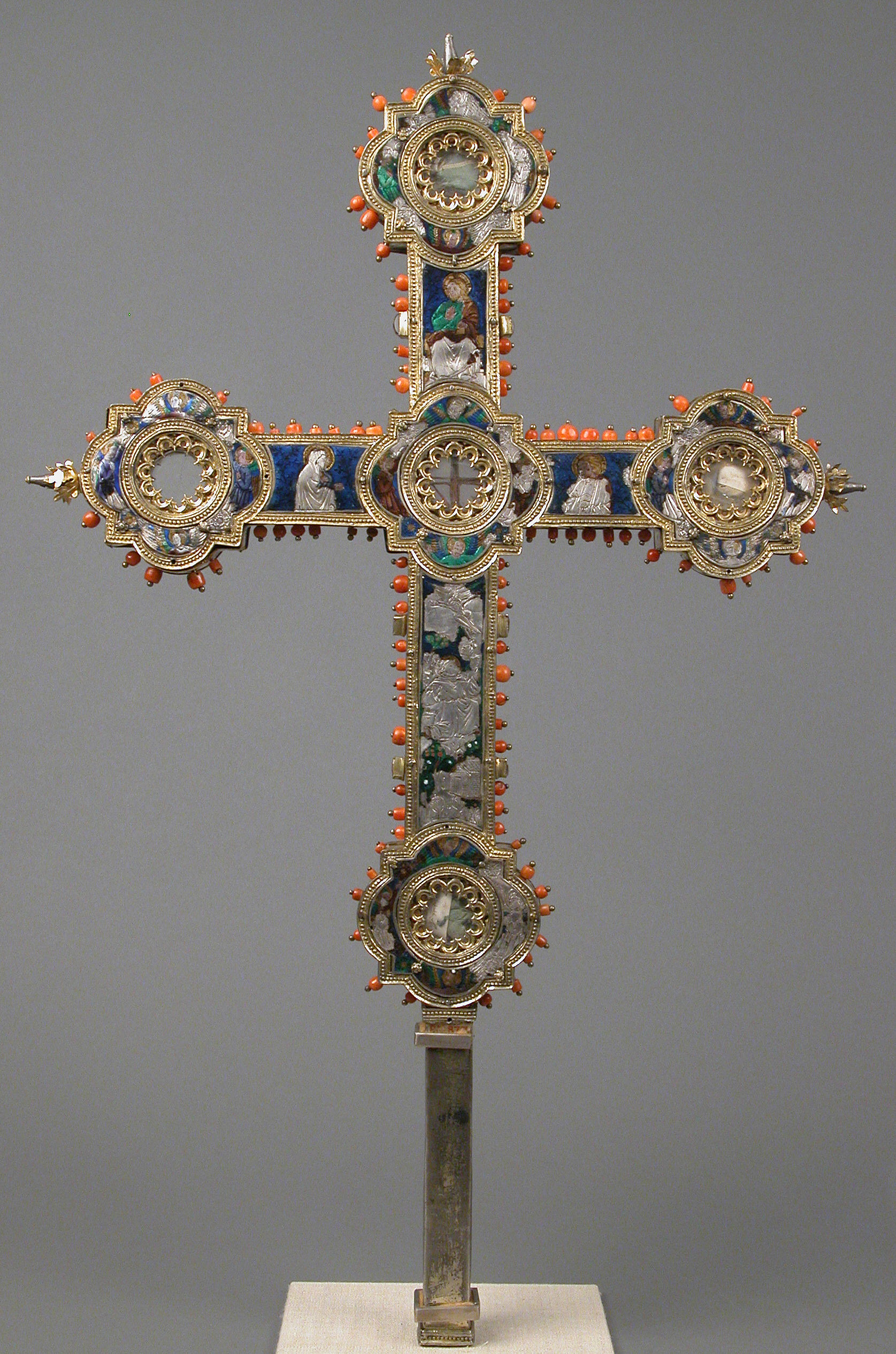
Reliquary Cross
Doctrinal reflection
This fourteenth-century Italian reliquary cross, held in the Medieval Art collection of the Metropolitan Museum of Art (Gift of J. Pierpont Morgan, 1917), represents a sophisticated intersection of devotional function and luxury craftsmanship characteristic of late medieval Italian goldsmith work. Constructed from translucent enamel, silver, gilded silver, coral, glass, rock crystal, and gold leaf, the object belongs to the Palaiologan-contemporary period in Western Europe, when reliquary production reached exceptional technical refinement. Its cross form is simultaneously a theological statement and a container: the instrument of crucifixion becomes the vessel housing a fragment of a saint's body or the True Cross, a practice documented in church inventories from at least the fourth century AD onward. Rock crystal, used here likely as a viewing window for the relic, was standard in high-status reliquaries precisely because its transparency allowed visual access to the sacred material while maintaining physical separation—a practical solution that also carried symbolic resonance with purity and incorruptibility in medieval material theology. Coral appears frequently in Italian medieval and Renaissance devotional objects, associated in the period's natural philosophy with apotropaic and medicinal properties, though Scripture assigns no such significance. The translucent enamel technique (émail de plique or basse-taille in related forms) flourished in fourteenth-century Italian workshops, particularly in Siena and the Po Valley, enabling pictorial detail within metalwork fields. Reliquary veneration and the theology of bodily resurrection undergirding it are documented as medieval Catholic devotional practice; Scripture affirms bodily resurrection (1 Corinthians 15:42–44) but does not prescribe relic custody. Scholarly consensus treats such objects primarily as material-culture evidence for medieval ecclesiology, patronage, and craft transmission. Sources: Gaborit-Chopin, Danielle, Émaux médiévaux; Hahnloser, Hans R., and Susanne Brugger-Koch, Corpus der Hartsteinschliffe; Metropolitan Museum of Art Bulletin.