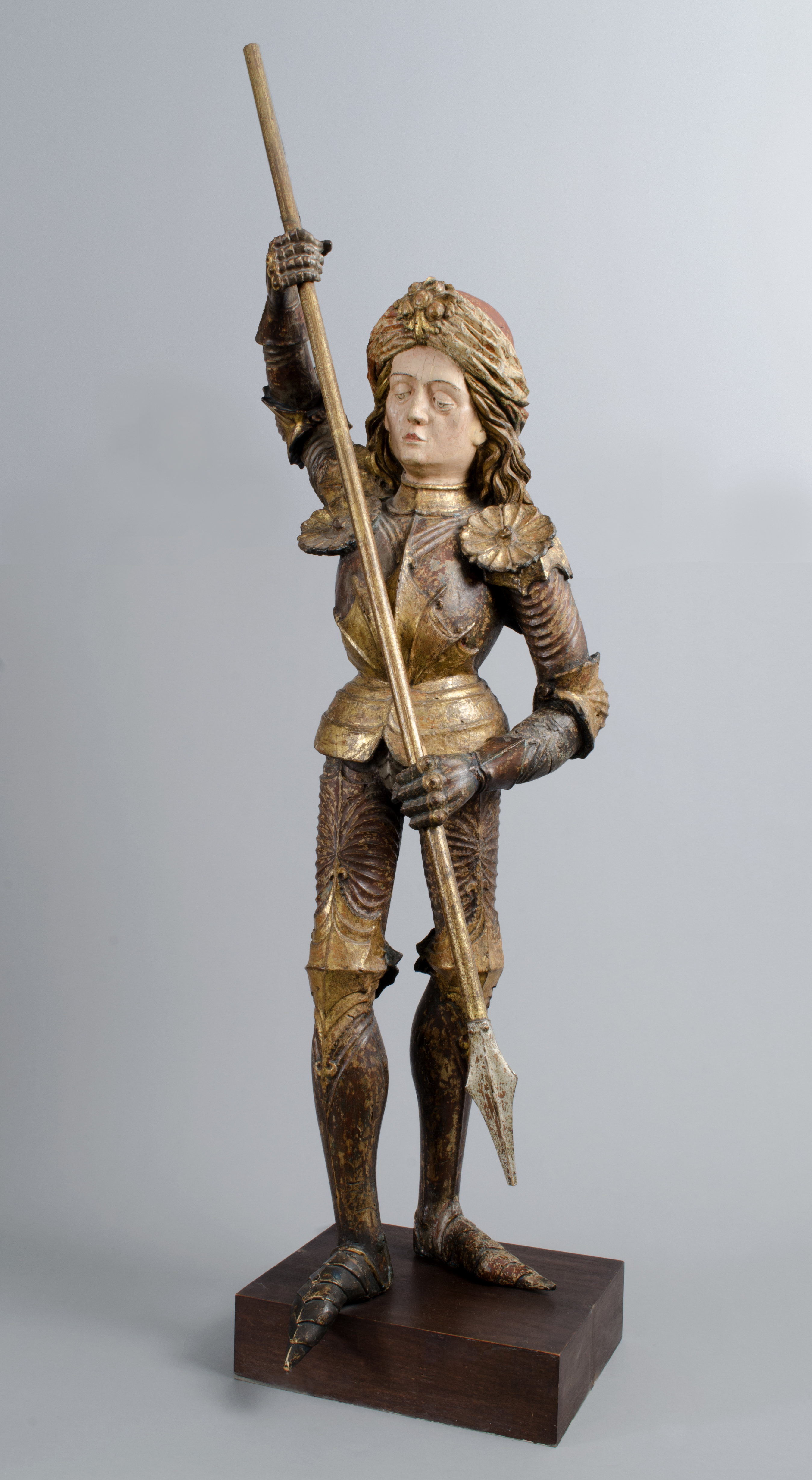
Saint George Slaying the Dragon
Doctrinal reflection
This entry presents an immediate classificatory challenge: the object in question is an Austrian polychrome wood sculpture of approximately 1480 AD, and therefore falls outside the Byzantine tradition entirely. It is a product of late Gothic Central European workshop practice, likely Austrian or broadly South German, employing carved limewood or similar local timber with applied polychromy and gilding. The subject—Saint George Slaying the Dragon—is, however, deeply embedded in Byzantine iconographic tradition, where George (Georgios) appears as a military martyr from at least the sixth century AD, his equestrian dragon-combat iconography crystallizing in middle Byzantine art and migrating westward through Crusader contact and manuscript transmission. In Byzantine icons and frescoes, the saint is rendered frontally or in three-quarter profile on a white horse, spear descending into the dragon's mouth, with the rescued princess and sometimes Emperor Diocletian in the background register. The present sculpture belongs instead to the Western Gothic sculptural tradition—dynamic contrapposto, naturalistic drapery, and illusionistic depth replace the hieratic flatness of Byzantine convention. As a Met acquisition from the J. Pierpont Morgan gift of 1916 AD, it holds provenance significance within the history of American collecting. Scholarly treatment of this object belongs to Gothic sculpture studies rather than Byzantine art history; cross-disciplinary interest lies in the transmission of the George iconotype from Eastern to Western Christian visual culture. Sources: Schiller, Gertrud, Iconography of Christian Art; Kazhdan, Alexander P., ed., Oxford Dictionary of Byzantium; Bagnoli, Martina, et al., Treasures of Heaven (2010).