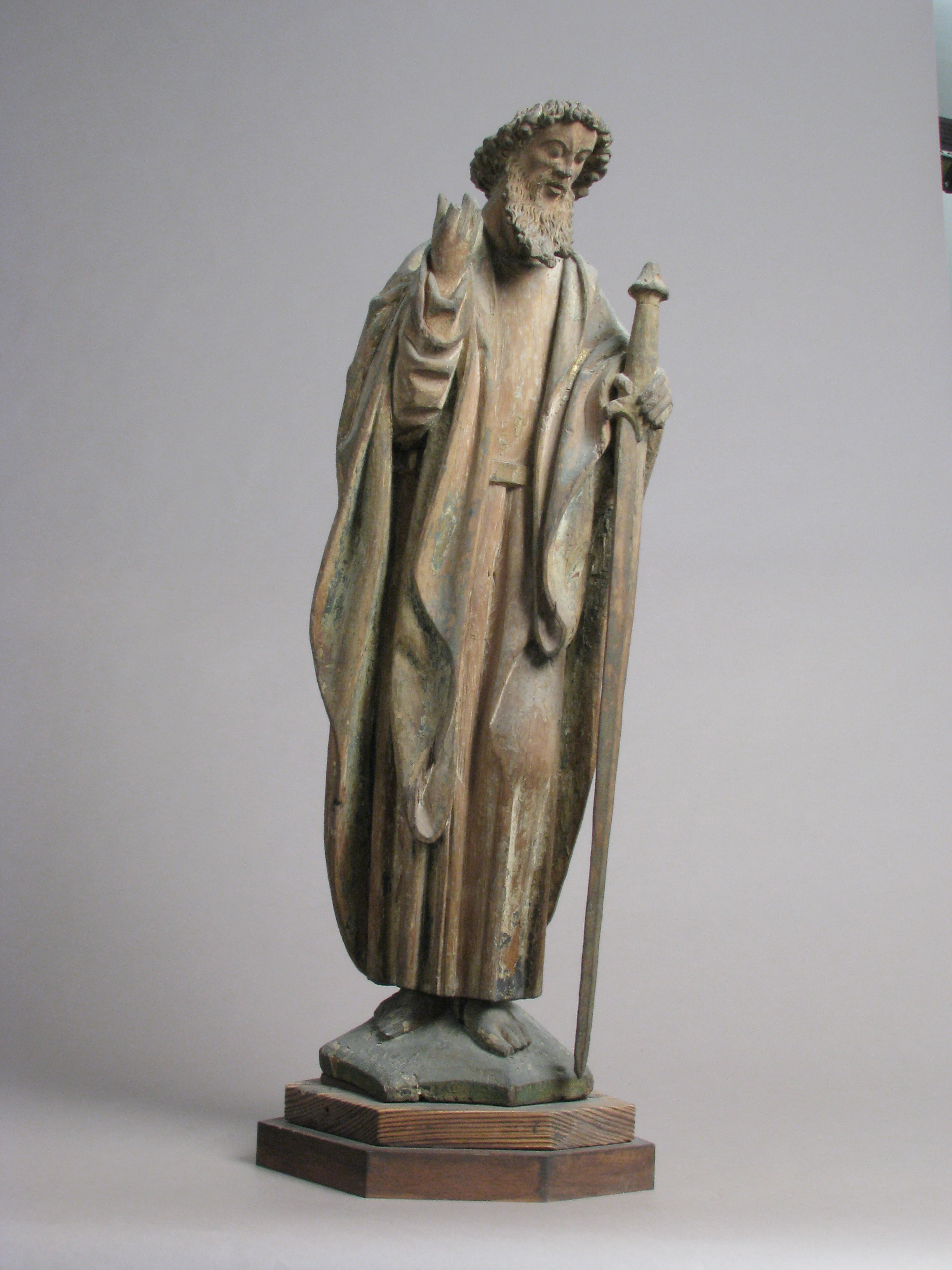
Saint Paul
Doctrinal reflection
This entry presents an archival challenge: the object in question—a North Netherlandish oak statuette of Saint Paul, ca. 1500 AD, with traces of polychromy and gilding, gifted by J. Pierpont Morgan to the Metropolitan Museum of Art in 1916—falls outside the strict parameters of Byzantine art production. It is a Northern European late Gothic sculptural work, likely originating from a workshop in the Low Countries during the final decades of the fifteenth century or the opening years of the sixteenth. As such, it belongs to the Western medieval tradition rather than the Eastern Christian aesthetic system that defines Byzantine iconographic practice. Nevertheless, the iconographic type of Saint Paul—typically depicted with a sword and codex or scroll, referencing his martyrdom and his epistolary corpus—has deep roots in early Christian art that Byzantine and Western traditions share. The attribute of the sword alludes to his beheading under Nero (ca. 64–68 AD), while the book signifies his authorship of the Pauline epistles. Late Gothic Netherlandish sculpture of this period is characterized by dynamic drapery, naturalistic facial treatment, and polychrome surface enrichment, all diverging markedly from the hieratic frontality and gold-ground conventions of Byzantine icons or mosaics. Scholarly assessment of such statuettes focuses on workshop attribution, dendrochronological analysis of oak panels, and the liturgical or devotional function within altarpiece programs. This object cannot be classified under the Scriptorium's Byzantine schema without significant methodological distortion. Sources: Steyaert, J., Late Gothic Sculpture: The Low Countries (1994); Williamson, P., Gothic Sculpture 1140–1300 (1995).