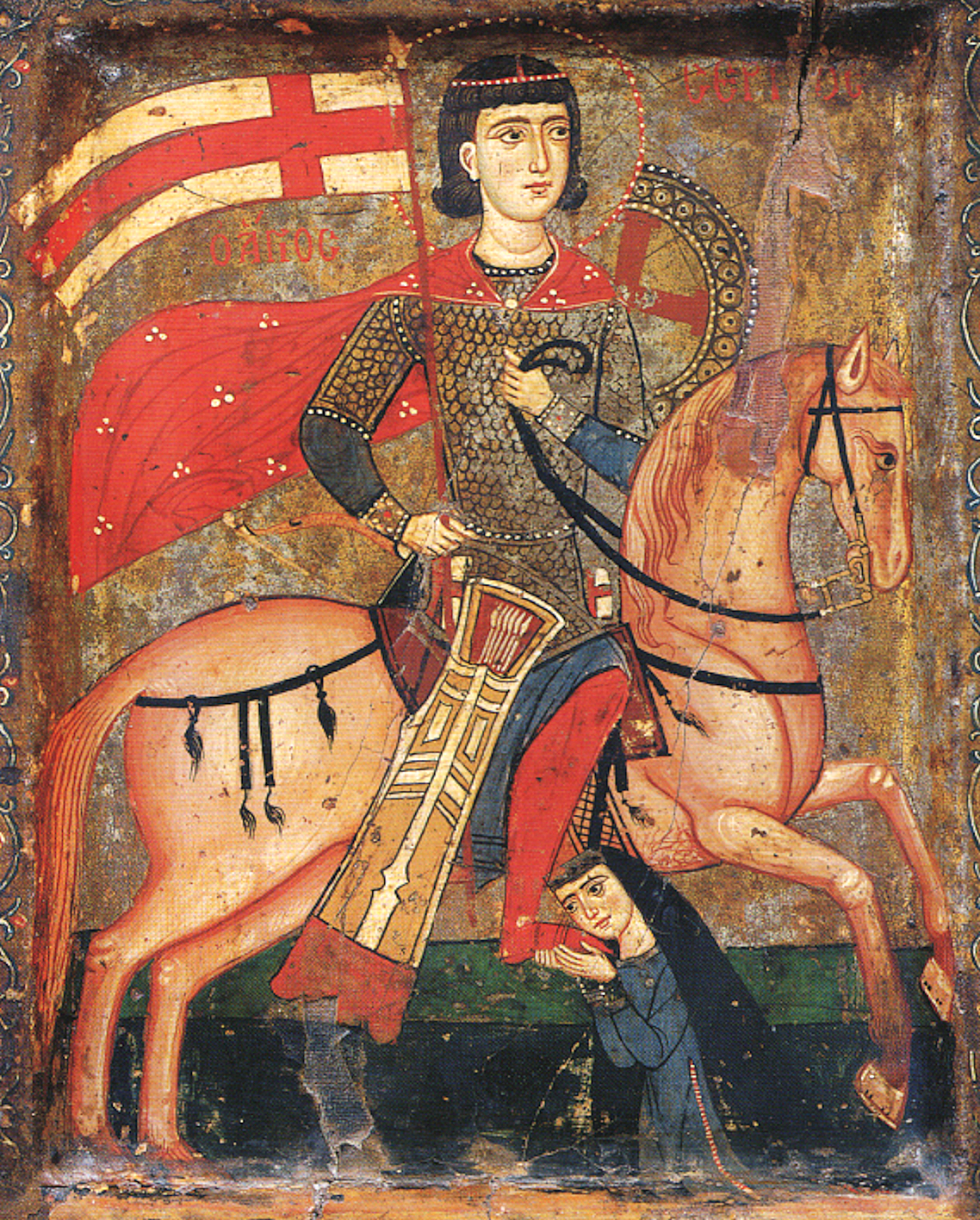
Saint Sergius on Horseback (Sinai)
Doctrinal reflection
This icon depicting Saint Sergius on Horseback with a Kneeling Donor dates to the second half of the 13th century AD and is preserved at Saint Catherine's Monastery, Mount Sinai. Executed in tempera on panel, it belongs to a distinctive group of icons produced in or around Sinai during the Crusader period, when the monastery served as a meeting point for Byzantine, Latin, and Eastern Christian artistic traditions. The image presents the military martyr Sergius in the equestrian mode, mounted on a white horse and clad in a soldier's garb, a compositional type well established in Byzantine art for warrior saints such as George and Demetrios. The small kneeling female donor figure at the lower margin identifies the work as a votive commission, her diminutive scale relative to the saint expressing hierarchical subordination and intercessory petition rather than narrative equivalence. The typological fusion evident here — Byzantine facial modeling and gold ground combined with a naturalistic rendering of the horse and a Western-inflected sense of spatial volume — reflects the hybrid workshop culture operating at Sinai under Crusader political influence in the Levant. Iconographically, the military martyr program evokes the theology of spiritual warfare and martyrdom articulated by early hagiographic tradition, while the donor portrait situates the object within the lived practice of pilgrimage devotion to the Holy Mountain. Scholarly attention has focused on the Sinai corpus as critical evidence for cross-cultural exchange in 13th-century panel painting. Sources: Kurt Weitzmann, 'The Icon' (1978); Jaroslav Folda, 'Crusader Art in the Holy Land' (2005); Holy Image, Holy Space: Icons and Frescoes from Greece (exhibition catalogue, 1988).