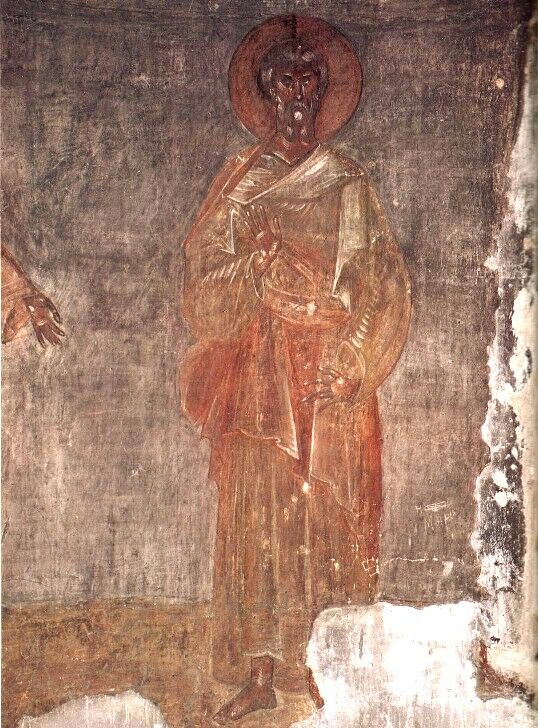
The Patriarch Enoch (Theophanes the Greek, Novgorod)
Doctrinal reflection
The figure of the Patriarch Enoch survives as part of Theophanes the Greek's celebrated fresco cycle executed in 1378 AD within the Church of the Transfiguration on Elijah Street (Spasa-Preobrazheniia na Ilyine) in Novgorod. Theophanes, a Constantinople-trained master who migrated to Rus' in the 1370s, is credited with introducing a distinctly Hesychast-inflected painterly vocabulary into the Rus' tradition, characterized by bold white highlights (bliki), compressed tonal modeling, and an expressive urgency absent from more hieratic Byzantine conventions. Enoch appears among a register of Old Testament righteous ancestors in the drum zone of the church, positioned within a theological program emphasizing prefigurations of divine light and transformative union with God—themes directly consonant with the Palamite theology Theophanes would have absorbed in Constantinople. Iconographically, Enoch is rendered as an aged prophet-patriarch, typically with white or grey hair, rendered in a three-quarter pose with heavily modeled, almost agitated drapery that exemplifies Theophanes's mature style. His inclusion in the cycle invokes the twin scriptural witnesses to his translation without death: Genesis 5:24, which records that 'God took him,' and Hebrews 11:5, which interprets this as a reward for his faith. Patristic commentary consistently read Enoch as a type of eschatological transformation, aligning him with the Transfiguration theme governing the entire decorative program. Theophanes's Novgorod frescoes remain the sole securely attributed surviving works of the master and constitute a benchmark for understanding late Byzantine monumental painting in the Slavic world. Sources: Dumbarton Oaks Papers; Zograf (Journal of Medieval Art); Oxford Handbook of Byzantine Art.