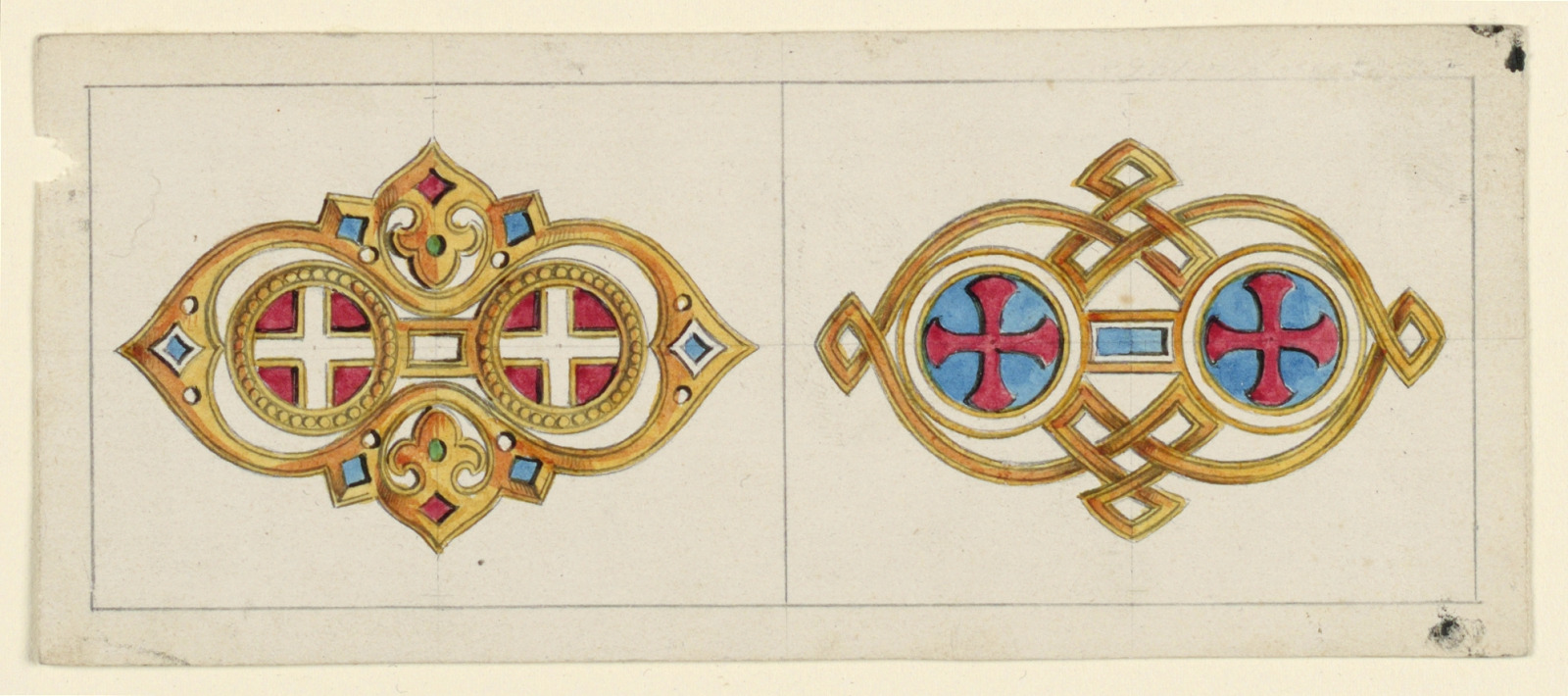
Two Designs for Brooches in the "Byzantine" Style
Doctrinal reflection
These two brooch designs in the 'Byzantine' style, executed in pen and brown ink, brush and watercolor, and graphite on white paper, are held at the Cooper Hewitt, Smithsonian Design Museum and dated to approximately AD 1860–1865, produced in Rome, Italy. They represent nineteenth-century Historicist revival design rather than medieval Byzantine artifact production proper. The small sheets (6.6 × 15.6 cm) depict paired compositional schemes: the left design centers on two circular medallions connected by a rectangular bridge element, framed within a pseudo-Gothic pointed arch; the right design repeats the paired-circle motif with red crosses upon blue grounds, encircled by an angularly interlaced band. Both designs synthesize Byzantine enameling conventions—cloisonné medallion formats, cross-charged roundels, and interlace ornament—with contemporaneous Gothic Revival framing devices, reflecting the syncretic historicism typical of mid-nineteenth-century European decorative arts. The cross-and-circle vocabulary loosely evokes Byzantine liturgical pectoral crosses and enkolpia, while the interlace recalls manuscript and metalwork ornament from the middle Byzantine period (AD 843–1204). Scholarly interest lies primarily in the reception history of Byzantium: these drawings document how Roman ateliers and designers interpreted and commodified 'Byzantine' aesthetics during the period of intense archaeological and antiquarian interest following publications such as those of the Didron circle and early Byzantine studies scholarship. They are design documents, not devotional objects, and are classified here under the manuscript medium as works on paper. Sources: Journal of Design History; Studies in the Decorative Arts; Journal of the Warburg and Courtauld Institutes.