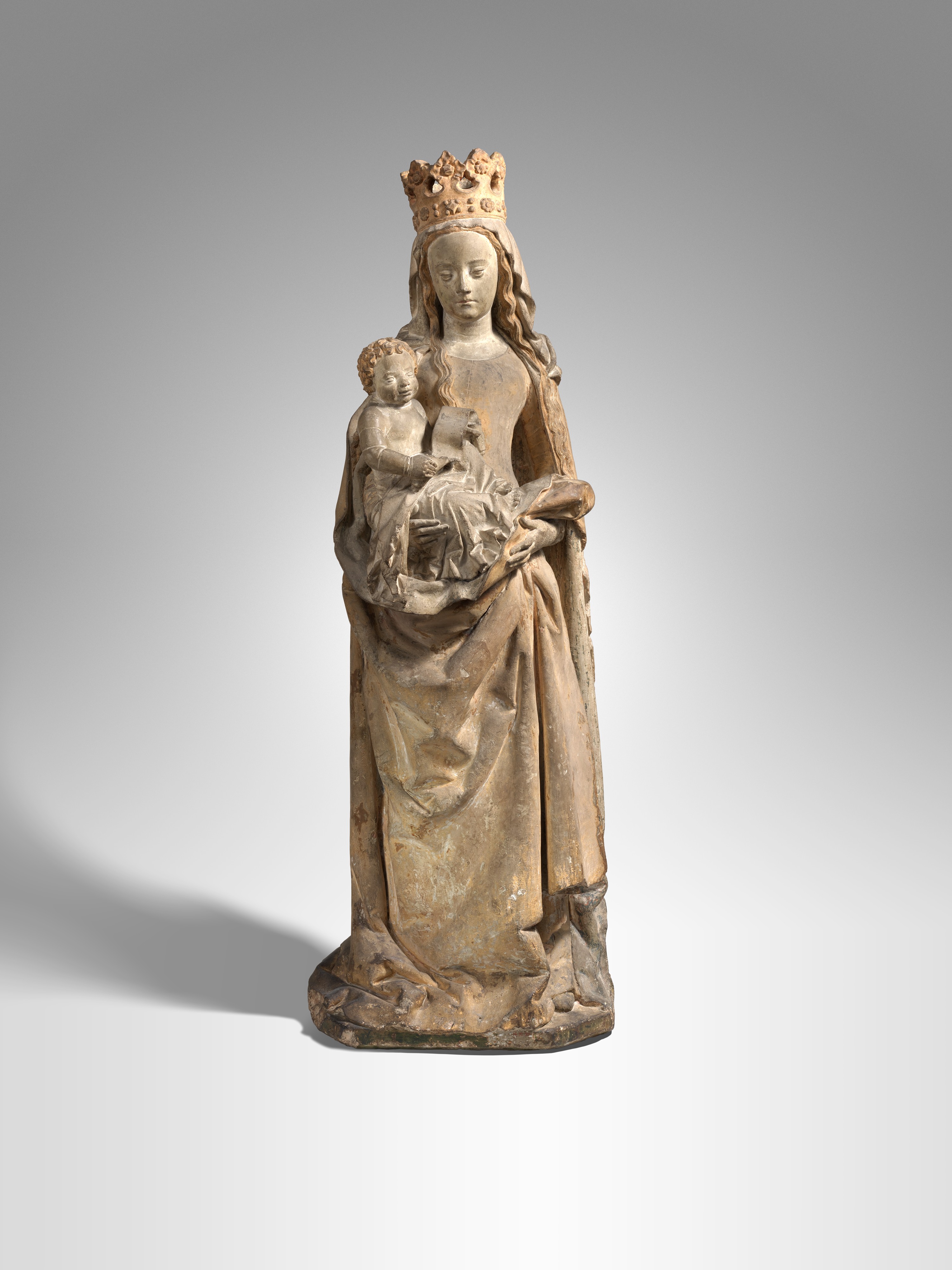
Virgin and Child
Doctrinal reflection
This French limestone sculpture of the Virgin and Child dates to the fifteenth century AD and is held in the Medieval Art collection of the Metropolitan Museum of Art (Gift of J. Pierpont Morgan, 1916). It is a Western Gothic work rather than a Byzantine artifact, catalogued here because its composition shares direct lineage with Byzantine Theotokos imagery — specifically the Hodegetria type, whose Greek name means 'she who shows the way.' That name is worth pausing on. In the original Byzantine formula the Virgin's free hand points to the Child: the composition's entire logic moves the eye through the mother to the son, the 'way' being Christ himself (John 14:6). The pairing of maternal tenderness with hieratic dignity encodes the two natures of Christ — the program's genuinely biblical freight (Luke 1:43; Matthew 1:23, God with us). Late medieval Western devotion, however, increasingly treated the pointing figure as herself an intercessor to whom prayer was addressed — a role that belongs to later Catholic tradition, not to Scripture, which names one mediator between God and men, the man Christ Jesus (1 Timothy 2:5), and never records prayer offered to Mary. Read as its own composition instructs, the statue preaches better than the devotion that grew around it: everything hands the viewer onward to the Child. The retention of polychromy reflects a pan-European medieval aesthetic with partial parallels in Byzantine painted icons, and scholarly analysis of such works addresses workshop attribution and the devotional contexts of late medieval French patronage. Sources: Gesta (International Center of Medieval Art); The Metropolitan Museum of Art Bulletin; Speculum (Medieval Academy of America).