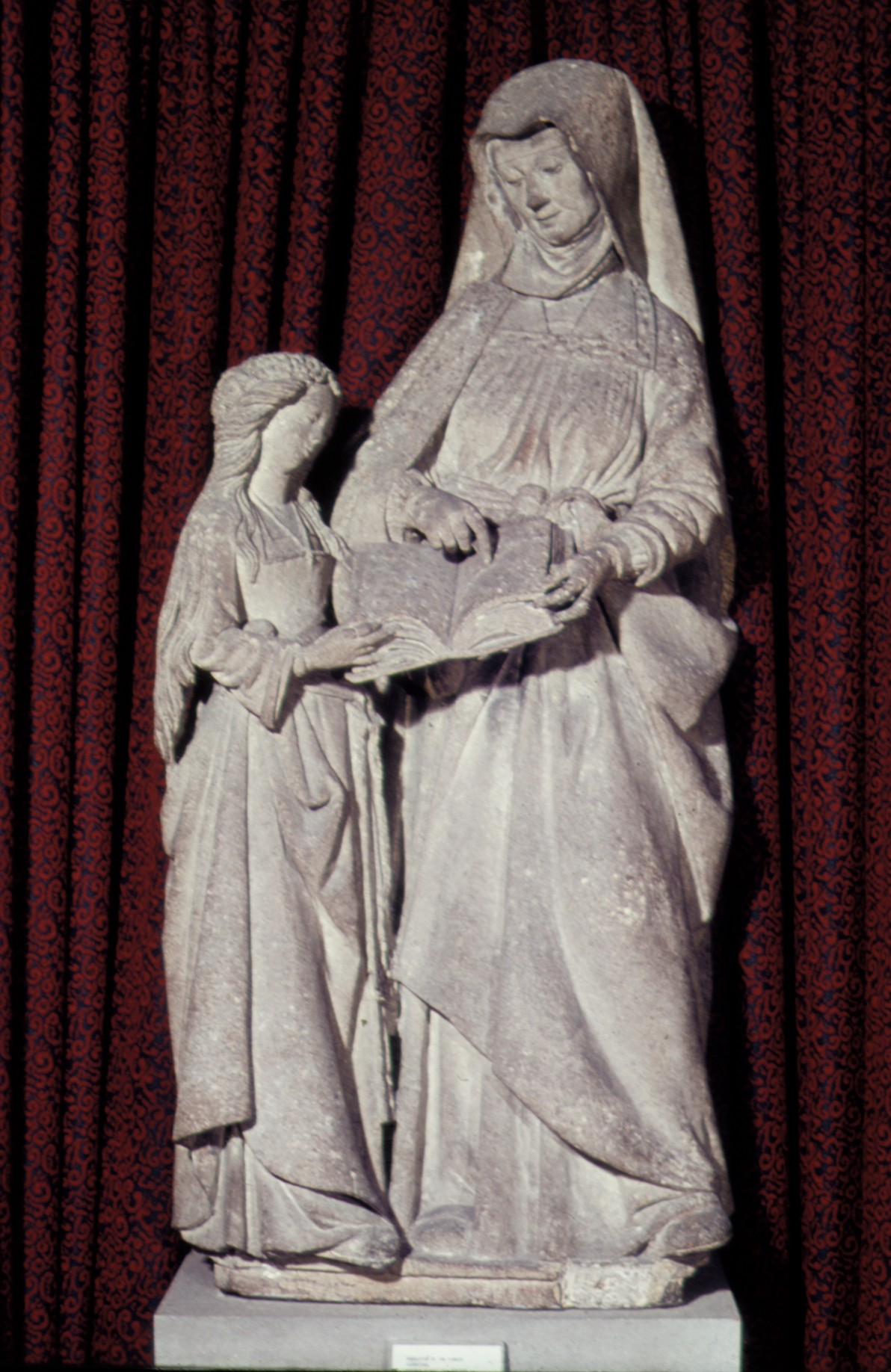
Education of the Virgin
Doctrinal reflection
The Education of the Virgin is a French sandstone sculptural relief dated to approximately AD 1510–1520, held in the Medieval Art collection of the Metropolitan Museum of Art (Gift of J. Pierpont Morgan, 1916). The subject — the young Mary instructed by her mother Anne, usually over an open book — has no basis in Scripture, which says nothing of Mary's childhood or her parents. The figure of Anne enters Christian storytelling through the Protoevangelium of James, a second-century apocryphal text, and the education scene itself is a later Western devotional development, popularized alongside the Legenda Aurea and the flourishing late medieval cult of Saint Anne that Franciscan and Dominican preaching promoted across Northern Europe. The scene's charm is real — a grandmother-figure teaching a child to read — and its assumption that Mary was raised on the Scriptures is not implausible for a devout Jewish household; her Magnificat (Luke 1:46-55) is woven from the language of Hannah's prayer and the Psalms, the song of someone who knew the text deeply. But the relief presents apocryphal narrative, and where late medieval devotion read the scene as marking Mary's singular predestined holiness, that reading belongs to the developing Marian doctrine of the period, not to the biblical record, which presents her as a faithful young woman who calls God 'my Saviour' (Luke 1:47). As sculpture, the sandstone medium and likely architectural provenance — a retable, trumeau, or choir-screen fragment — situate the work in early sixteenth-century French production, residual Gothic drapery meeting emergent Renaissance proportion in the Flamboyant-Renaissance transition. Sources: Gesta: International Center of Medieval Art; Speculum: A Journal of Medieval Studies; Metropolitan Museum of Art Bulletin.